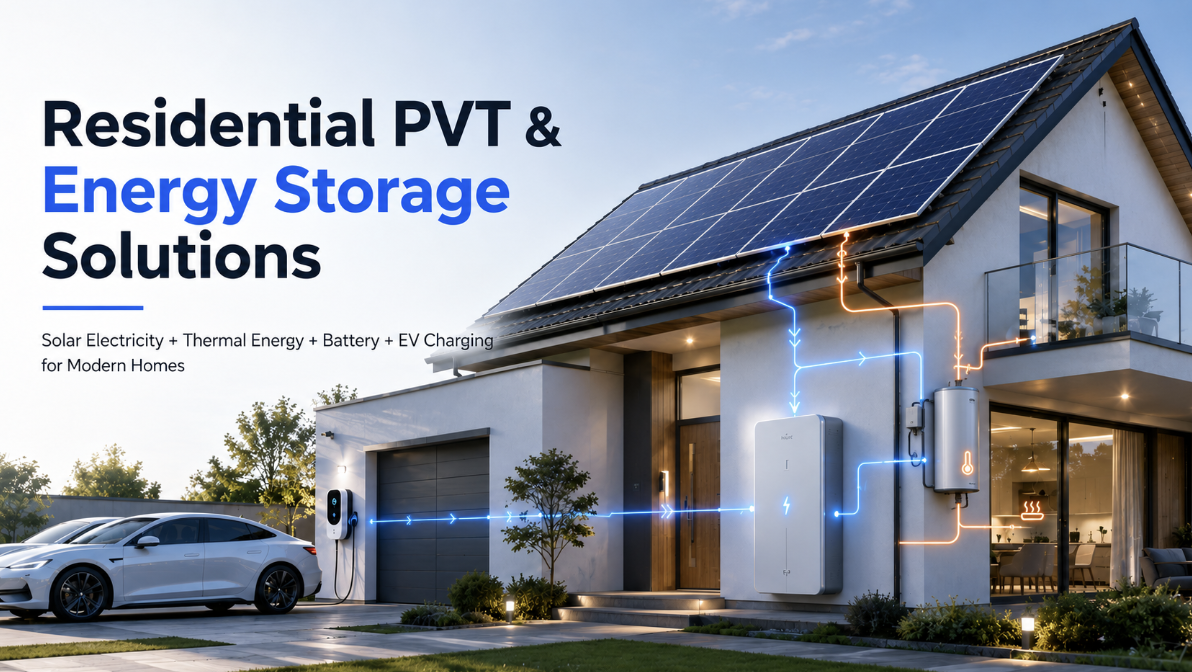
Solar Electricity + Thermal Energy + Battery + EV Charging + Heating + Hot Water Integration
As residential energy demand continues to grow, homeowners are no longer looking only for a basic rooftop solar system. More families are now considering integrated home energy solutions that combine PVT panels, battery storage, EV charging, electric heating, and hot water systems into one smarter energy platform.
A residential PVT and energy storage solution can help households generate electricity, collect usable thermal energy, reduce grid dependence, improve backup power capability, increase energy self-consumption, and build a cleaner, more efficient home energy system.
What Is a Residential PVT & Energy Storage System?
A residential PVT and energy storage system is an integrated home energy solution that uses rooftop PVT panels to generate electricity and collect heat at the same time.
Unlike traditional PV panels that only generate electricity, PVT panels combine photovoltaic power generation with thermal energy collection. The electricity can be used for household loads, battery charging, and EV charging, while the collected heat can support domestic hot water, space heating, or heat pump systems.
When solar resources are sufficient, the system can supply household electricity, charge the battery, power an EV charger, and provide thermal energy for hot water or heating. When solar production is low or during grid outages, the battery can provide backup power for essential home loads.
A complete residential solution may include:
- PVT modules
- Hybrid inverter
- Battery energy storage system
- Thermal storage tank
- Home energy management system
- EV charging unit
- Heat pump water heater
- Electric heating or heat pump system
- Smart meter and monitoring app
- Optional backup generator interface
Why Residential Energy Systems Are Moving Toward All-in-One Integration
Traditional home solar systems mainly focused on generating electricity. However, modern households have more complex energy needs, including EV charging, heating, cooling, hot water, backup power, and smart energy management.
This is why the latest market trend is moving toward all-in-one home energy systems. Instead of installing separate equipment that works independently, integrated systems connect PVT power generation, thermal energy collection, battery storage, EV charging, and heating loads through one energy management platform.
This allows homeowners to use solar energy more efficiently and reduce waste. For example, when solar conditions are strong, the system can first supply household loads, then charge the battery, then provide heat for domestic hot water, and finally charge an EV depending on user priority and system settings.
Available Solution 1: Basic PVT + Battery Backup System
This solution includes rooftop PVT panels, a hybrid inverter, battery storage, and a basic thermal collection system.
During the day, the electrical output from the PVT panels supplies household loads and charges the battery. At the same time, the thermal output can be collected and stored for domestic hot water or low-temperature heating applications.
At night, the battery supplies stored electricity. During a power outage, the system can support essential loads such as lighting, refrigerator, Wi-Fi, security system, garage door, and selected outlets.
This solution is suitable for homeowners who want to reduce electricity bills, improve backup power capability, and make better use of rooftop solar energy.
Available Solution 2: PVT + Battery + EV Charging
For households with electric vehicles, PVT-storage-charging integration is becoming increasingly valuable.
The system allows homeowners to charge EVs with solar electricity when available. Battery storage can help balance household demand and reduce peak grid consumption. With smart energy management, the EV charger can be scheduled to operate during solar production periods or lower electricity tariff periods.
Compared with a traditional PV-only system, PVT can also provide thermal energy for household hot water or heating demand, improving the total energy utilization of the rooftop system.
This solution is suitable for EV owners, families with high daytime solar generation, and homes looking to reduce both transportation and household energy costs.
Available Solution 3: PVT + Battery + Hot Water Storage
Hot water is one of the major energy loads in a home. By combining PVT panels, battery storage, and a hot water storage tank, homeowners can convert solar energy into both electricity and stored thermal energy.
The water tank works like a thermal battery. When solar conditions are strong, the system can use collected heat to preheat or produce domestic hot water. This reduces the need to use grid electricity or gas for water heating and improves overall solar energy utilization.
This solution is suitable for homes with high hot water demand, villas, rural homes, all-electric homes, and households aiming to reduce gas or grid electricity consumption.
Available Solution 4: PVT + Battery + Heat Pump Heating + Hot Water
This is a more advanced residential energy solution. It combines PVT panels, battery storage, heat pump heating, and heat pump water heating into one home energy system.
The system can use solar electricity to support household loads, charge the battery, and power heat pump equipment. At the same time, PVT thermal output can support domestic hot water or improve the efficiency of heating-related applications.
With intelligent control, heating and hot water loads can be shifted to times when solar generation is strong or electricity prices are lower.
This solution is especially suitable for markets where home electrification is growing, natural gas prices are high, or homeowners want cleaner heating alternatives.
Available Solution 5: Residential All-in-One PVT-Storage-Charging-Heating System
The most advanced direction is the all-in-one home energy system.
This type of solution integrates PVT panels, battery storage, EV charging, electric heating, hot water storage, smart monitoring, and energy management into one coordinated platform.
The core value is not only energy storage, but whole-home energy optimization. The system can decide how to use solar electricity and solar thermal energy based on real-time household load, battery state of charge, EV charging demand, heating demand, hot water temperature, electricity price, weather conditions, and backup power requirements.
A typical energy priority strategy can be:
- First, supply household electrical loads.
- Second, charge the battery.
- Third, collect and store thermal energy for domestic hot water.
- Fourth, support heating or heat pump operation.
- Fifth, charge the EV.
- Sixth, export excess electricity to the grid if allowed.
This approach helps homeowners maximize both solar electricity and solar thermal utilization, improve energy independence, and create a more resilient residential energy system.
Key Benefits of Residential PVT & Energy Storage Solutions
Residential PVT-storage systems provide several important benefits:
- Electricity generation and thermal energy collection from one rooftop system
- Reduced electricity bills
- Reduced hot water and heating energy costs
- Higher total solar energy utilization
- Backup power during outages
- Lower dependence on grid electricity and gas
- Cleaner home energy use
- EV charging with solar power
- Smart control of heating and hot water
- Improved energy resilience
- Flexible expansion for future household loads
For many households, the value of the system is not only saving electricity, but also improving comfort, safety, hot water availability, and long-term energy independence.
How to Choose the Right System Configuration
The best system configuration depends on the homeowner's actual energy needs. Before designing a residential PVT and energy storage system, the following factors should be evaluated:
- Daily electricity consumption
- Daily hot water demand
- Heating demand
- Roof space and solar resources
- Battery backup requirement
- EV charging demand
- Local electricity and gas prices
- Grid connection policy
- Available installation space
- Thermal storage tank size
- Budget and expansion plan
- Need for generator backup
For small households, a basic PVT + battery system may be enough. For EV owners, PVT-storage-charging integration is more suitable. For all-electric homes or homes with high hot water demand, adding heat pump heating and thermal storage can significantly improve total energy efficiency.
Typical Applications
Residential PVT and energy storage solutions are suitable for:
- Single-family homes
- Villas
- Townhouses
- Rural homes
- Off-grid homes
- Homes with EV charging demand
- All-electric homes
- Homes with high hot water demand
- Residential backup power applications
- Self-sufficient smart home energy systems
Future Trend: From Home Battery to Home Energy Hub
The residential energy market is moving from simple battery backup to full home energy management. Future systems will not only store electricity, but also coordinate solar power generation, thermal energy collection, EV charging, heating, cooling, hot water, grid tariffs, and backup power.
For homeowners, this means lower energy costs, cleaner energy use, better comfort, and more control over household electricity and heat. For energy solution providers, it creates new opportunities to deliver integrated, customized, and intelligent residential energy systems.
A well-designed residential PVT-storage-charging-heating solution can turn a home into a smarter, cleaner, and more self-sufficient energy unit.