
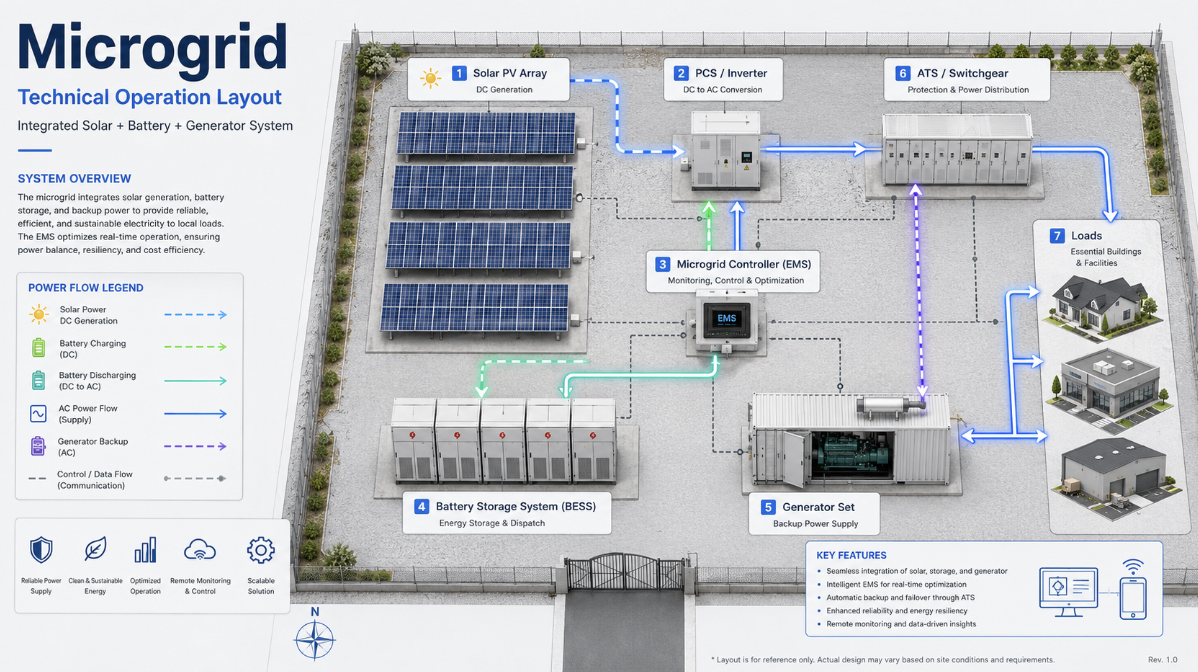
What Is a Microgrid?
A microgrid is a localized energy system that can generate, store, and manage electricity independently or together with the main utility grid. It usually combines multiple power sources such as generator sets, solar PV, battery storage, wind power, and intelligent control systems.
Microgrids are widely used in remote communities, islands, mines, industrial parks, military bases, telecom sites, farms, and critical facilities where power reliability is essential.
Grid-Connected and Off-Grid Microgrids
Microgrids can be divided into two main types: grid-connected microgrids and off-grid microgrids.
A grid-connected microgrid works together with the utility grid. It can reduce electricity costs, improve energy efficiency, and provide backup power during grid outages.
An off-grid microgrid operates independently without relying on the main grid. It is suitable for remote areas where grid access is unavailable, unstable, or too expensive to build.
Main Components of a Microgrid System
A typical microgrid system may include:
- Diesel or gas generator sets
- Solar PV system
- Battery energy storage system
- Power conversion system
- ATS and switchgear
- Microgrid controller
- Distribution system
- Remote monitoring platform
The control system is the brain of the microgrid. It manages power generation, battery charging and discharging, load priority, generator start-stop, and overall energy optimization.
Benefits of Microgrid Solutions
Microgrids improve power reliability by using multiple energy sources. If one power source is unavailable, the system can automatically switch to another source.
They can also reduce fuel consumption by using renewable energy and battery storage. For remote sites, this means fewer fuel deliveries, lower operating costs, and improved energy independence.
Microgrids also support cleaner energy development by integrating solar PV and other renewable energy technologies.
Typical Applications
Microgrid systems are suitable for:
- Remote communities
- Islands
- Mining operations
- Oil and gas fields
- Industrial parks
- Telecom stations
- Farms and agricultural facilities
- Military and emergency sites
- Commercial buildings
- Data centers and critical infrastructure
Why Microgrid Design Must Be Customized
No two microgrid projects are exactly the same. System design depends on load profile, power capacity, fuel availability, solar resources, backup requirements, operating hours, and environmental conditions.
A professional microgrid solution should balance reliability, cost, renewable energy usage, and long-term operation efficiency. For customers seeking stable and independent power, microgrids are one of the most practical energy solutions.