
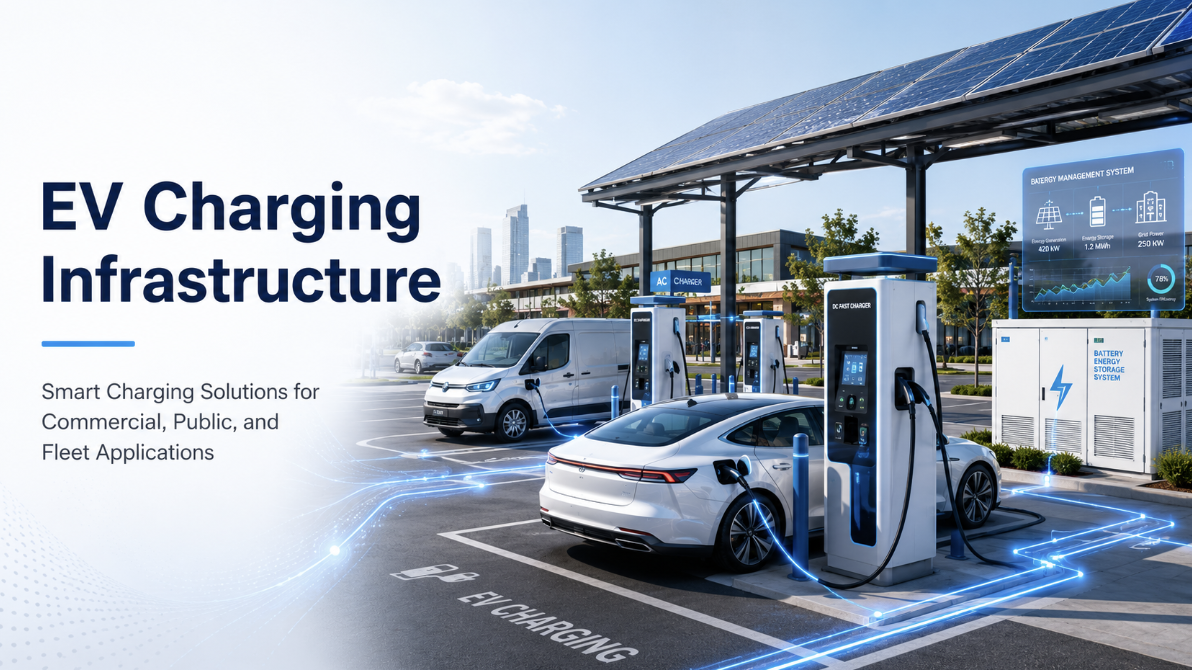
Understanding EV Charging Infrastructure for Commercial and Industrial Applications
As electric vehicles become more widely used, EV charging infrastructure is no longer limited to residential charging. Commercial buildings, logistics fleets, bus depots, industrial parks, parking lots, highway service areas, and public charging networks all require stable, scalable, and commercially viable charging solutions.
For EV charging operators, a successful project is not only about installing chargers. It also requires proper site planning, grid capacity evaluation, energy cost control, charging speed design, payment system integration, maintenance planning, and long-term business operation.
A professional EV charging system must consider charging demand, power distribution, grid limitations, safety, energy storage, renewable energy integration, and future expansion.
Main Types of EV Chargers
EV charging systems are generally divided into AC chargers and DC fast chargers.
AC chargers are commonly used for homes, workplaces, hotels, shopping malls, office buildings, and long-duration parking areas. They are cost-effective and suitable for overnight or slow charging.
DC fast chargers provide higher charging power and are suitable for public charging stations, fleet depots, highway service areas, taxi charging, bus charging, logistics charging, and commercial fast-charging applications.
For some remote, temporary, or weak-grid locations, mobile EV charging units, battery-supported charging systems, or generator-backed charging systems can also be used.
What EV Charging Operators Need to Know
For charging station operators, the key challenge is not only how to build the station, but how to make the station profitable and sustainable.
Before investing in an EV charging project, operators should evaluate:
- Site traffic and vehicle flow.
- Target users and charging behavior.
- Charging speed requirements.
- Electricity cost and peak demand charges.
- Grid capacity and upgrade cost.
- Land or parking space cost.
- Equipment investment and installation cost.
- Payment and billing system.
- Operation and maintenance cost.
- Future expansion potential.
A charging station with poor site selection or oversized equipment may have a long payback period. A well-designed charging station can improve charger utilization, reduce energy costs, and create multiple revenue streams.
Common Profit Models for EV Charging Operators
EV charging operators can generate revenue in several ways depending on the project location and business model.
- Charging Service Fees
This is the most direct revenue model. Operators charge users based on electricity consumption, charging time, parking time, or service fees. For public charging stations, DC fast chargers usually have higher service value because they provide faster charging and higher turnover. - Fleet Charging Contracts
For logistics companies, taxi fleets, delivery vehicles, buses, and corporate fleets, operators can provide dedicated charging services through long-term contracts. This model offers more stable demand and predictable revenue compared with open public charging. - Parking + Charging Revenue
Commercial buildings, malls, hotels, business parks, and parking operators can combine parking fees with EV charging services. Charging can also increase customer stay time and improve site value for retail and commercial properties. - Solar-Storage-Charging Energy Savings
By integrating solar PV and battery energy storage, operators can reduce grid electricity consumption, lower peak demand, and improve energy efficiency. Battery storage can charge during low-cost periods and discharge during peak charging demand, helping operators reduce operating costs. - Advertising and Site Partnership
Public charging stations can generate additional revenue through screen advertising, brand partnerships, nearby retail cooperation, and membership programs. For high-traffic sites, charging infrastructure can also become part of a broader commercial ecosystem. - Backup and Emergency Charging Service
In remote areas, industrial parks, highways, and disaster-response scenarios, generator-backed or battery-supported charging systems can provide emergency and temporary charging services. This model is suitable for weak-grid regions, temporary projects, construction sites, events, and fleet operations.
Why Energy Storage Is Important for EV Charging
High-power EV charging can create a large demand on the electrical grid. In areas where grid capacity is limited, battery energy storage can help reduce peak load, stabilize power output, and improve charging reliability.
For operators, energy storage is not only a technical upgrade. It can directly affect project profitability.
Battery energy storage can help:
- Reduce peak demand charges.
- Avoid expensive grid upgrades.
- Improve charger availability.
- Support high-power fast charging.
- Store low-cost electricity for peak use.
- Increase solar energy self-consumption.
- Provide backup power during outages.
When combined with solar PV, energy storage, and backup generators, EV charging stations become more flexible and energy-efficient. This is especially useful for fleet charging, commercial charging sites, industrial parks, and off-grid or weak-grid areas.
Solar-Storage-Charging Integration
The future of EV charging is not only about chargers. More projects are moving toward integrated solar-storage-charging systems.
A solar-storage-charging station combines solar PV, battery energy storage, EV charging equipment, intelligent energy management, and optional backup generators.
This system can use solar power to supply chargers during the day, store excess energy in batteries, and support charging during peak demand or grid outages.
For operators, this approach can help reduce electricity costs, improve energy independence, and build a cleaner charging station image.
Key Factors in EV Charging Project Design
Before building an EV charging site, several factors should be evaluated:
- Number and type of vehicles.
- Required charging speed.
- Daily charging demand.
- Available grid capacity.
- Peak load and power distribution.
- Site layout and parking flow.
- Charger utilization rate.
- Payment and operation platform.
- Energy storage requirement.
- Solar PV integration possibility.
- Backup power requirement.
- Future expansion plan.
A well-designed system can improve charging efficiency, reduce operating costs, and avoid unnecessary grid upgrade expenses.
Typical Applications
EV charging infrastructure can be used in:
- Fleet depots.
- Logistics centers.
- Bus stations.
- Taxi charging stations.
- Commercial parking lots.
- Shopping malls.
- Hotels and office buildings.
- Public charging stations.
- Highway service areas.
- Industrial parks.
- Temporary and remote charging sites.
How PowerGen Helps EV Charging Operators
Local EPC Support for EV Charging Projects
For EV charging infrastructure projects, equipment supply is only one part of the complete project. Site construction, electrical installation, grid connection, civil works, testing, commissioning, and local compliance are also critical to project success.
PowerGen can support customers with localized EPC coordination in selected markets through local partners, engineering teams, and project resources. Depending on the project location and customer requirements, we can help coordinate complete or partial EPC services, including site assessment, system design, equipment supply, installation support, electrical connection, commissioning guidance, and project delivery support.
This helps charging station operators reduce project complexity, improve implementation efficiency, and move from planning to operation more smoothly.
Project Financing Support in Selected Markets
For some EV charging, solar-storage-charging, microgrid, and distributed energy projects, initial investment can be a major challenge for operators and project owners.
PowerGen can support financing discussions for qualified projects in selected countries and regions, depending on project scale, local policy, asset structure, customer credit profile, and investment feasibility.
Available financing support may include project financing coordination, equipment financing discussion, investor connection, phased investment planning, or cooperation with local financial and project partners.
This support is especially valuable for fleet charging stations, public charging networks, industrial parks, commercial energy projects, and solar-storage-charging infrastructure where long-term cash flow can support project development.
From Equipment Supply to Project Delivery
PowerGen aims to support EV charging operators throughout the full project cycle:
- Project consultation.
- Site and load requirement analysis.
- Technical solution design.
- EV charger and energy storage selection.
- Solar-storage-charging system integration.
- Backup power configuration.
- Local EPC coordination in selected markets.
- Financing support discussion for qualified projects.
- Installation and commissioning guidance.
- After-sales and technical service.
By combining equipment supply, system integration, local project execution support, and financing coordination, PowerGen helps customers build EV charging projects that are technically reliable, commercially viable, and easier to implement.
PowerGen provides more than EV charging equipment. We support customers with integrated energy system design, solar-storage-charging solutions, local EPC coordination in selected markets, and financing support discussions for qualified projects, helping operators build reliable, scalable, and commercially viable charging infrastructure.